This is one of the cleaner case studies we've ever been able to publish, because every claim in it can be re-verified by anyone reading. Lockerfella is a Brewood locksmith, covering South Staffordshire and a fair chunk of the West Midlands. The site launched on 8 April 2026 on 365i Linux web hosting. It was designed and built by our sister studio, Press Forge. It's not a WordPress site. It's hand-rolled PHP, CSS, and vanilla JavaScript, sat on the 365i platform with the 365i CDN and the Web Optimisations panel doing the delivery work.
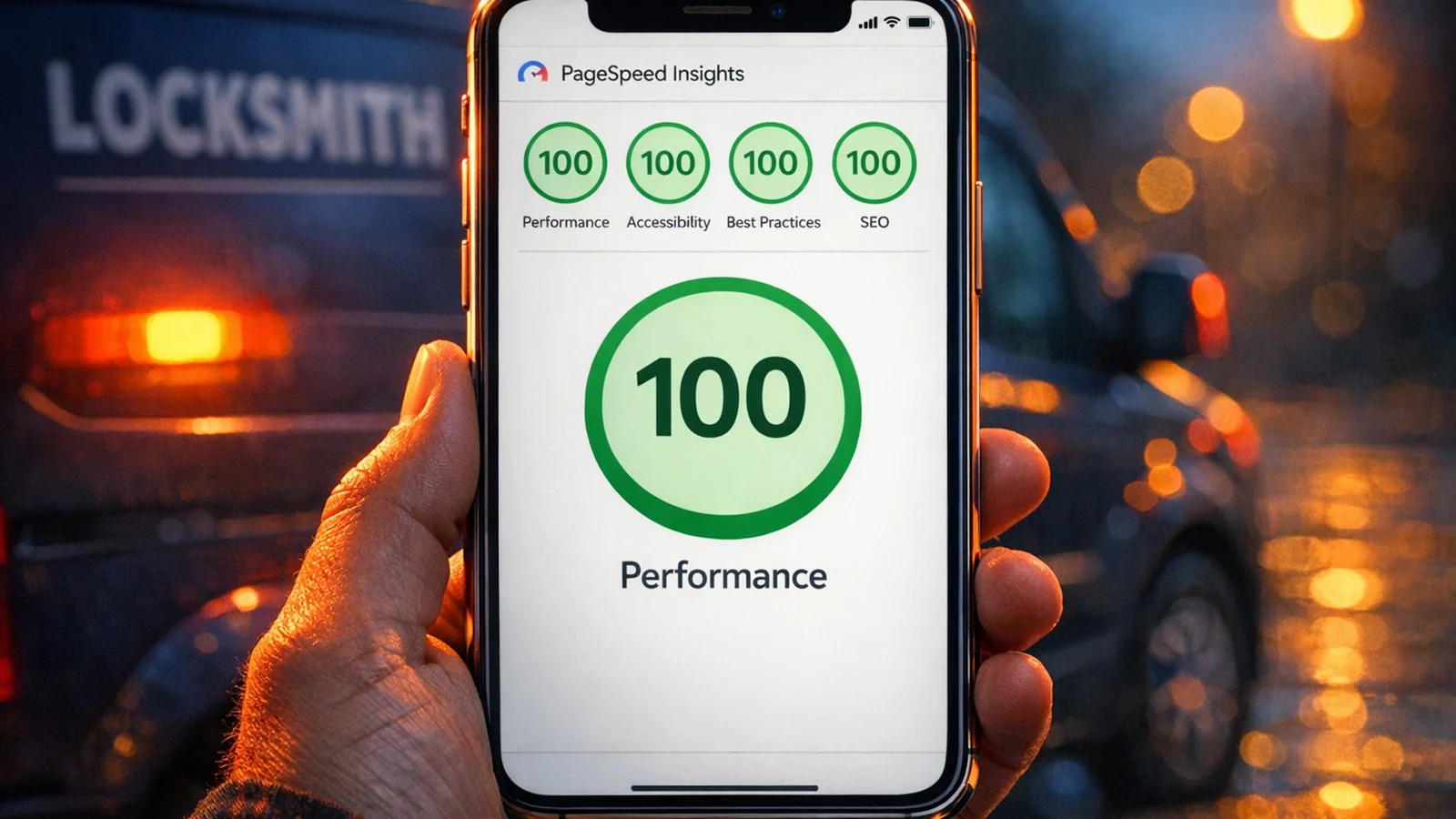
And from the day it went live, it scored a clean 100 / 100 / 100 / 100 on mobile PageSpeed Insights. No warm-up. No iteration to get there. Day one.
That's the story we want to tell here. Not just the numbers, but what hosting actually contributed to those numbers, where the build did work the platform could not, and why a brand-new domain with no backlinks and no reviews ended up the #1 result for "Brewood Locksmith" on Google, ChatGPT, and Gemini inside two weeks.
The result, in numbers
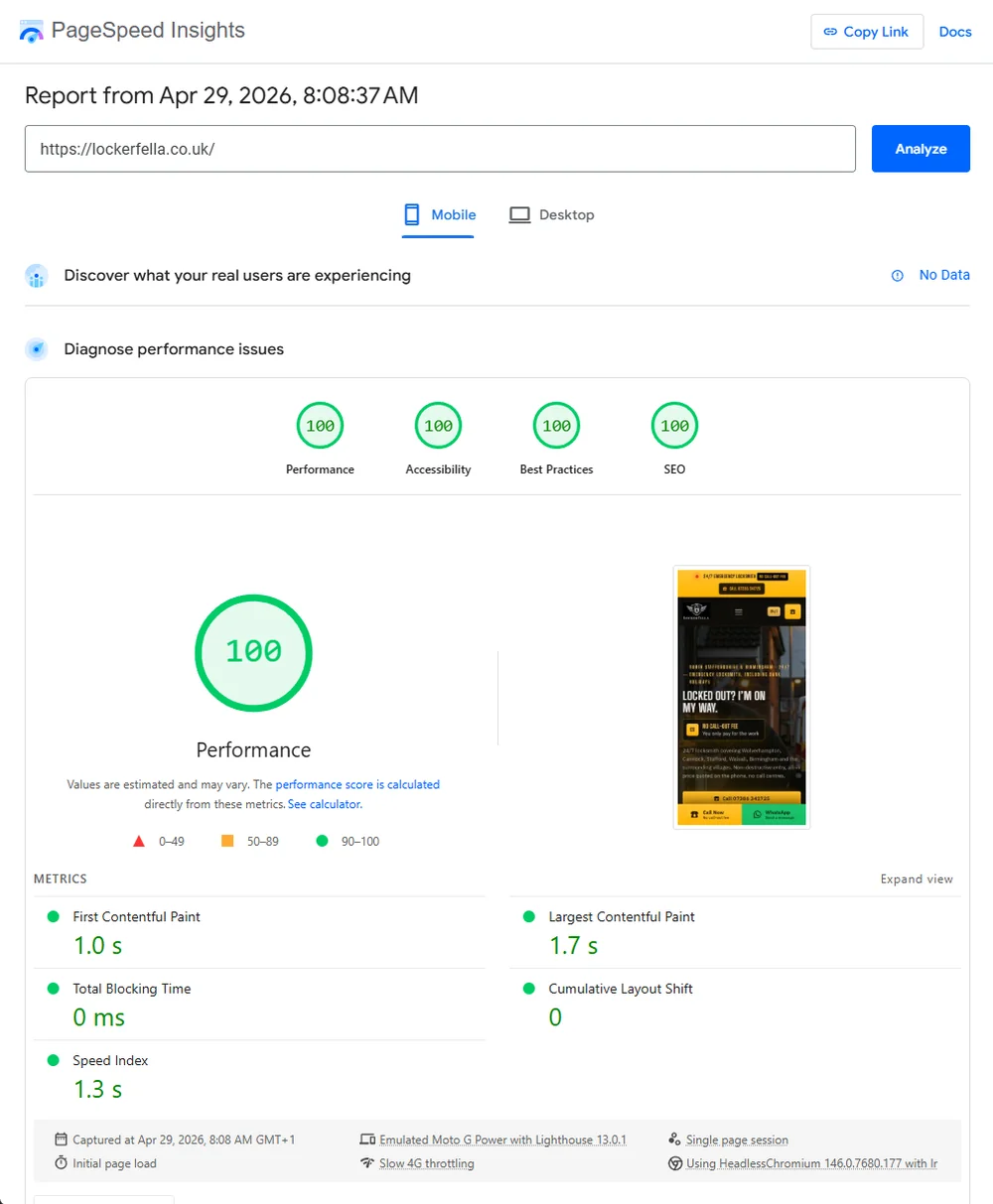
Mobile, not desktop. Emulated Moto G Power, 4G throttled. Captured this morning on the production site. Anyone reading this can re-run the test and see numbers in the same band. The score moves a point or two with the testing edge node and the time of day, but Lockerfella has held in the high 90s every time we've checked, and 100 across the board most of the time.
The other half of the story is the one that drew the brief in the first place. By day 10 to 12, in our tests captured at the end of April 2026, Lockerfella was the #1 organic result on Google, the #1 recommendation in ChatGPT, and the #1 listing in Gemini for the query "Brewood Locksmith". With zero backlinks at launch. Zero reviews on the site. A domain Google had never seen before.
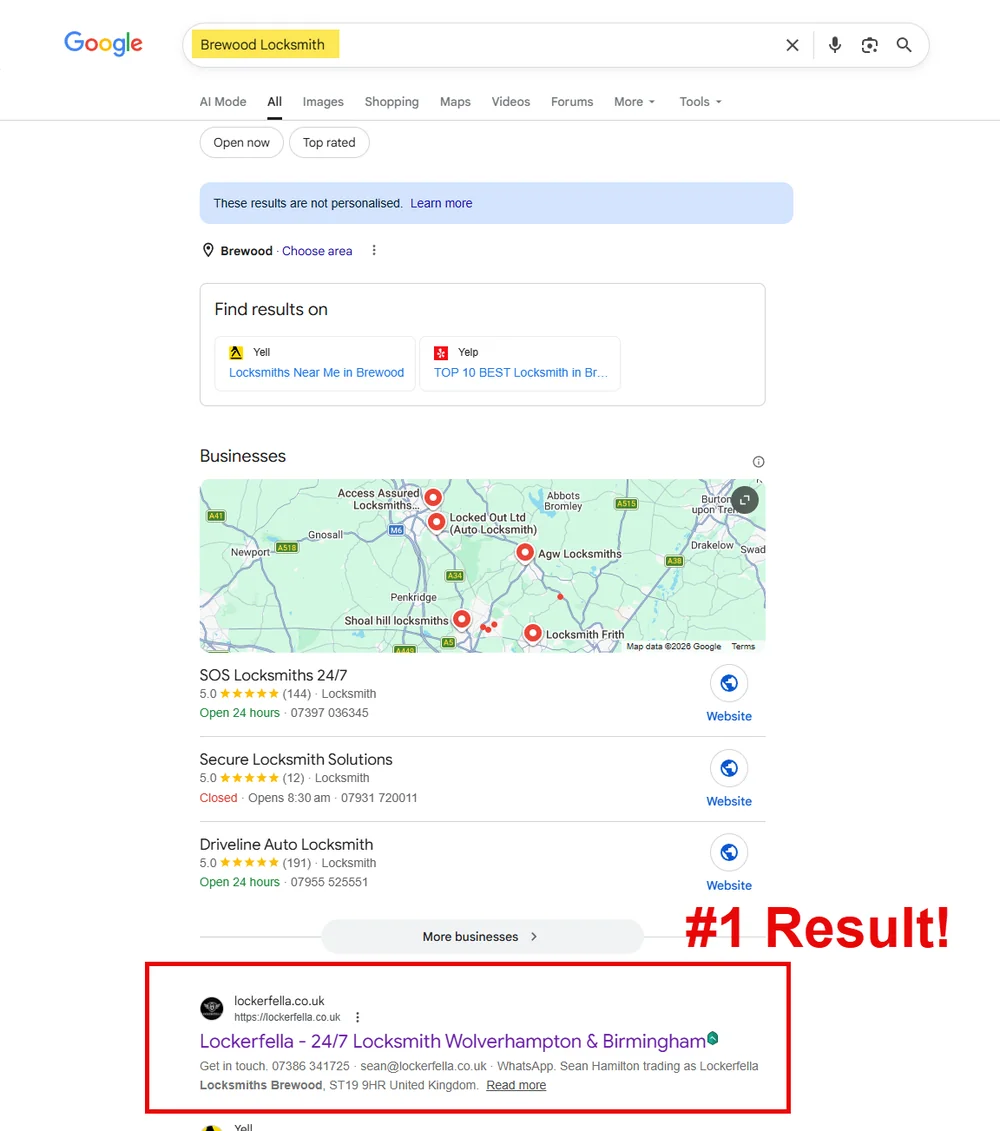
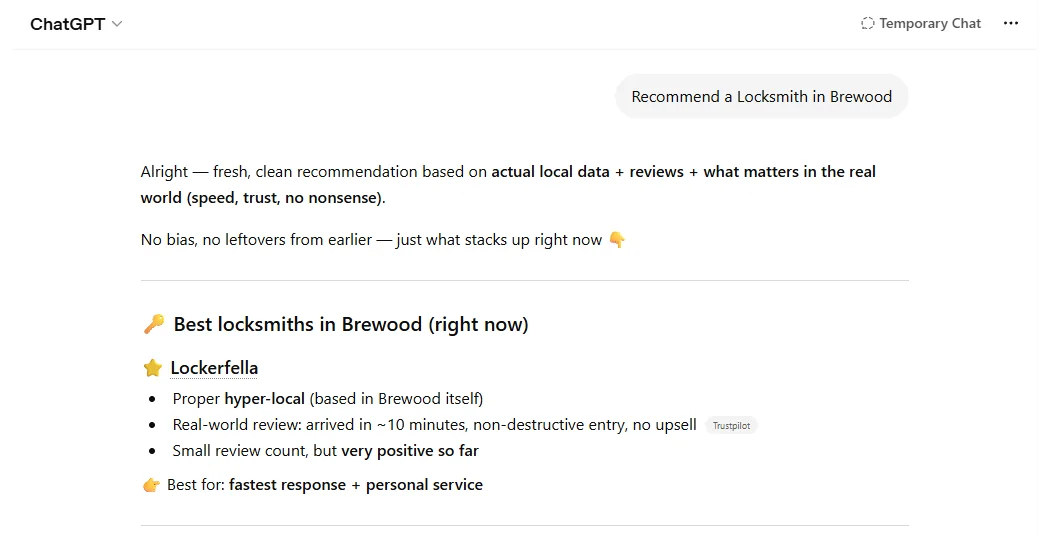
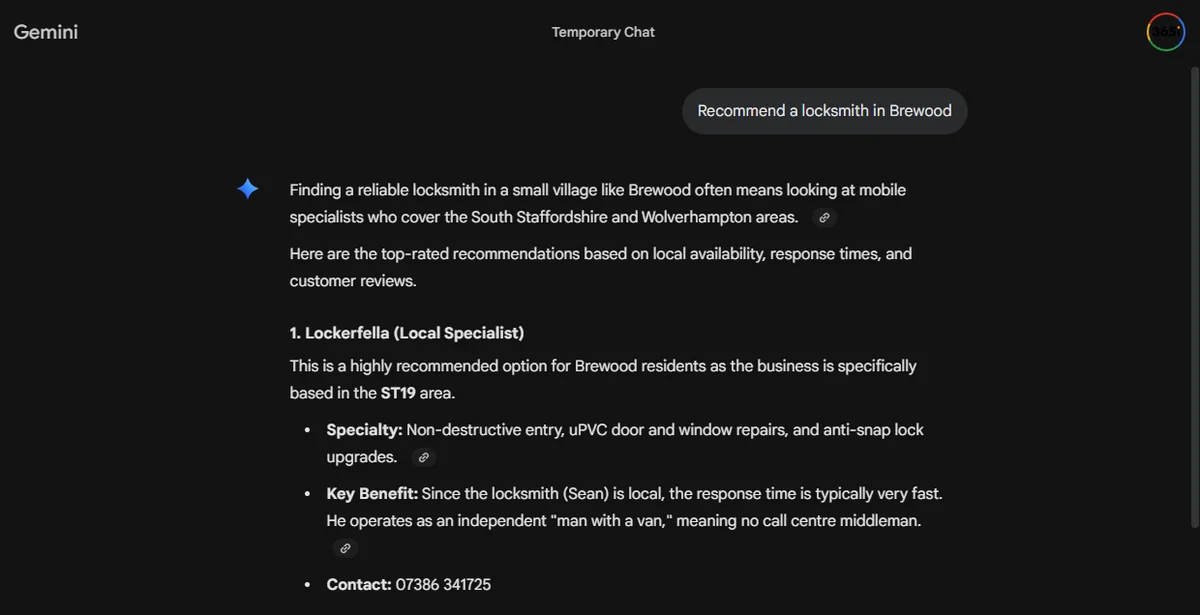
Neither of the AI engines hallucinated. They quoted Sean's actual specialisms and his actual operating area, sourced from page content and schema. Both linked back to the site. The Google result outranked competitors with established sites and dozens of reviews. It also helped that nothing was stopping the AI engines reading the site in the first place, which is not a given on every WordPress host.
"The site just flies." Sean Hamilton, owner of Lockerfella, the day after launch.
Lockerfella by the numbers
The PageSpeed score is the headline figure, but the page-level metrics underneath it are the bit other small-business sites should look at, because they're the levers that produced the score. We measured these on the live site this morning, on a request hitting the 365i CDN edge.
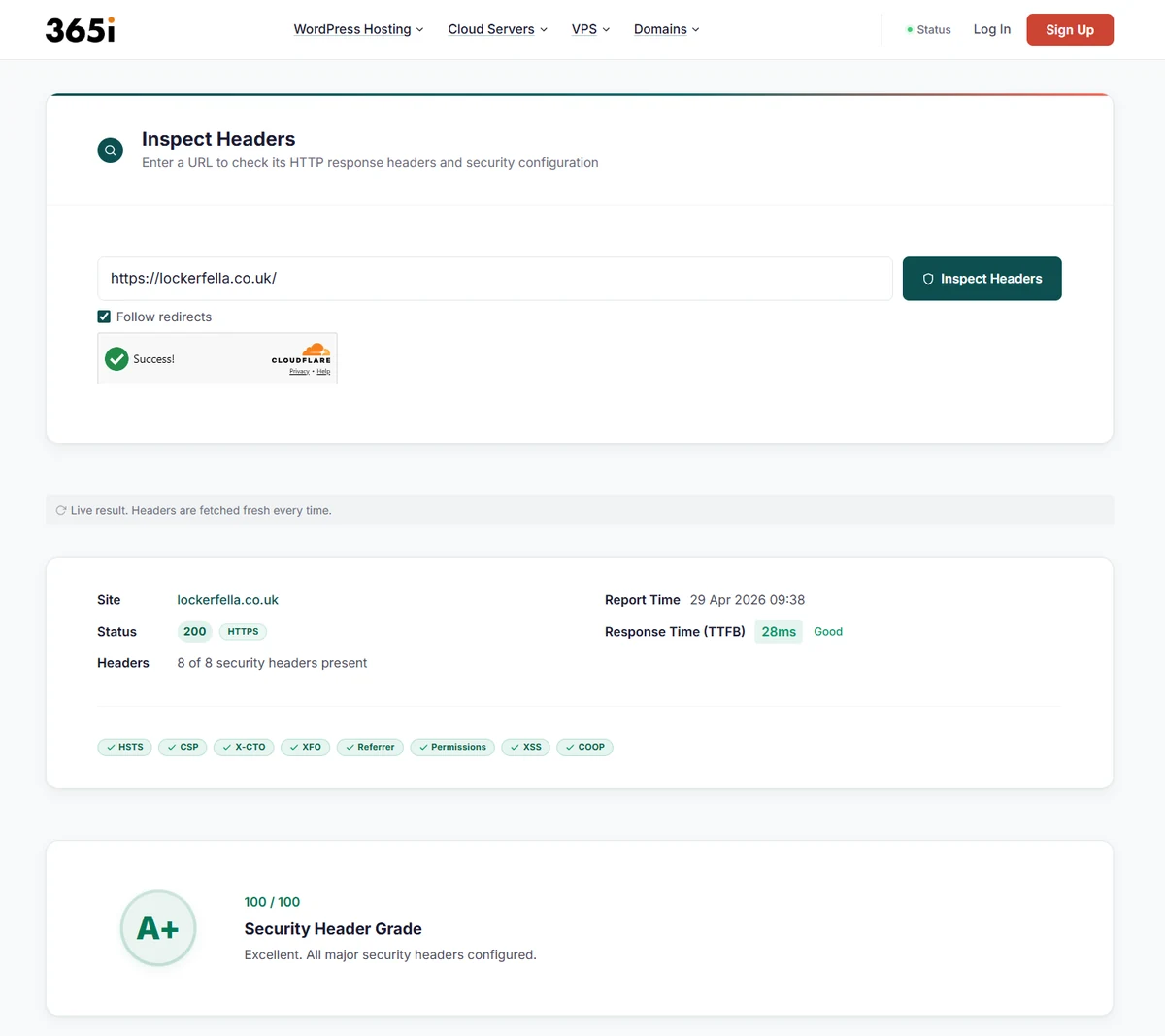
That 28 ms is the server-side TTFB at origin, measured by the tool itself. Add the visitor's own DNS, TLS handshake, and network distance on top and you'll get the full round-trip your browser actually feels, which is still well inside the band where Largest Contentful Paint stays "Good". The typical UK budget shared host returns 400 ms to 1,400 ms on this same metric. The gap is the difference between a site that feels instant and one that feels slow.
And the A+ security grade is the under-celebrated half of why this site reads as credible to AI engines and humans alike. Eight of eight critical security response headers are present: HSTS, Content-Security-Policy, X-Content-Type-Options, X-Frame-Options, Referrer-Policy, Permissions-Policy, XSS, and Cross-Origin-Opener-Policy. Most UK small-business sites we audit ship with two or three at most.
Two of those numbers are worth pausing on. Zero external stylesheets is a deliberate build choice from Press Forge: every byte of CSS is inlined into the HTML head, so the browser has the full style budget the moment the document arrives. There's no second round-trip for a stylesheet, no render-blocking download, no flash of unstyled content. That alone is worth a clean second on First Contentful Paint over the typical WordPress build.
And 34.8 KB compressed HTML is what a fast small-business homepage should look like in 2026. The typical UK small-business site we measure on hosting audits ships somewhere between 800 KB and 3 MB of total page weight before images. Lockerfella's whole homepage, HTML and inlined CSS together, fits in under 35 KB on the wire. Three JavaScript files (reviews carousel, main script, FAQ accordion), all minified, all served from edge cache with 180-day retention.
The platform half (TTFB under 60 ms, edge-served assets) and the build half (lean HTML, inlined CSS, three JS files) are what compose into a 1.0-second First Contentful Paint and a 1.7-second Largest Contentful Paint on a throttled mid-range Android phone. These aren't aspirational targets. They're the numbers on the live site as you read this.
Why hosting was only half the story
Most "great hosting" case studies show a 70 to 92 PageSpeed bump after a migration. That's a real win, and it's what hosting is supposed to do. But the reason we wanted to write Lockerfella up is that the more interesting story isn't the hosting on its own. It's what happens when the hosting and the build are both non-commodity.
Here's the breakdown the way we'd describe it internally:
- The platform sets the floor. Linux on the 365i stack, PHP 8.5 available, the 365i CDN with global edge caching, and the Web Optimisations panel rewriting HTML, CSS, JavaScript, and images on the way out. That stack is what makes a 1.7-second LCP possible.
- The build determines the ceiling. If you put a heavy templated WordPress theme on the same hosting, the same panel, the same CDN, you'd land in the 80s on mobile PageSpeed. To hit a clean 100 you need a build that knows what it's doing: lean PHP, hand-written CSS, no framework bloat, no render-blocking JavaScript, an LCP image that arrives with
fetchpriority="high", semantic markup, real schema. That's the Press Forge half of this case study. - The two compose. Take either away and you don't get to 100. Slow hosting under a great build still chokes at the network layer. Fast hosting under a bloated build still has too many bytes to deliver and too much main-thread work to do on a low-end Android phone.
This is the part of "fast hosting" articles that usually gets glossed over. Hosting is the largest single factor in performance for the average site, but it's a foundation, not a finish. We've seen that pattern enough times that it's the first thing we say to anyone migrating to us with PageSpeed expectations.
Our sister team has written up the build half of this project in their Lockerfella website case study: the trust architecture, the eighteen area pages, the transparent pricing decisions, and how each design call maps to the E-E-A-T signals Google and the AI engines look for. Read alongside this piece, the two together explain how the 100/100/100/100 result actually composes.
100/100/100/100 at launch: what the platform did
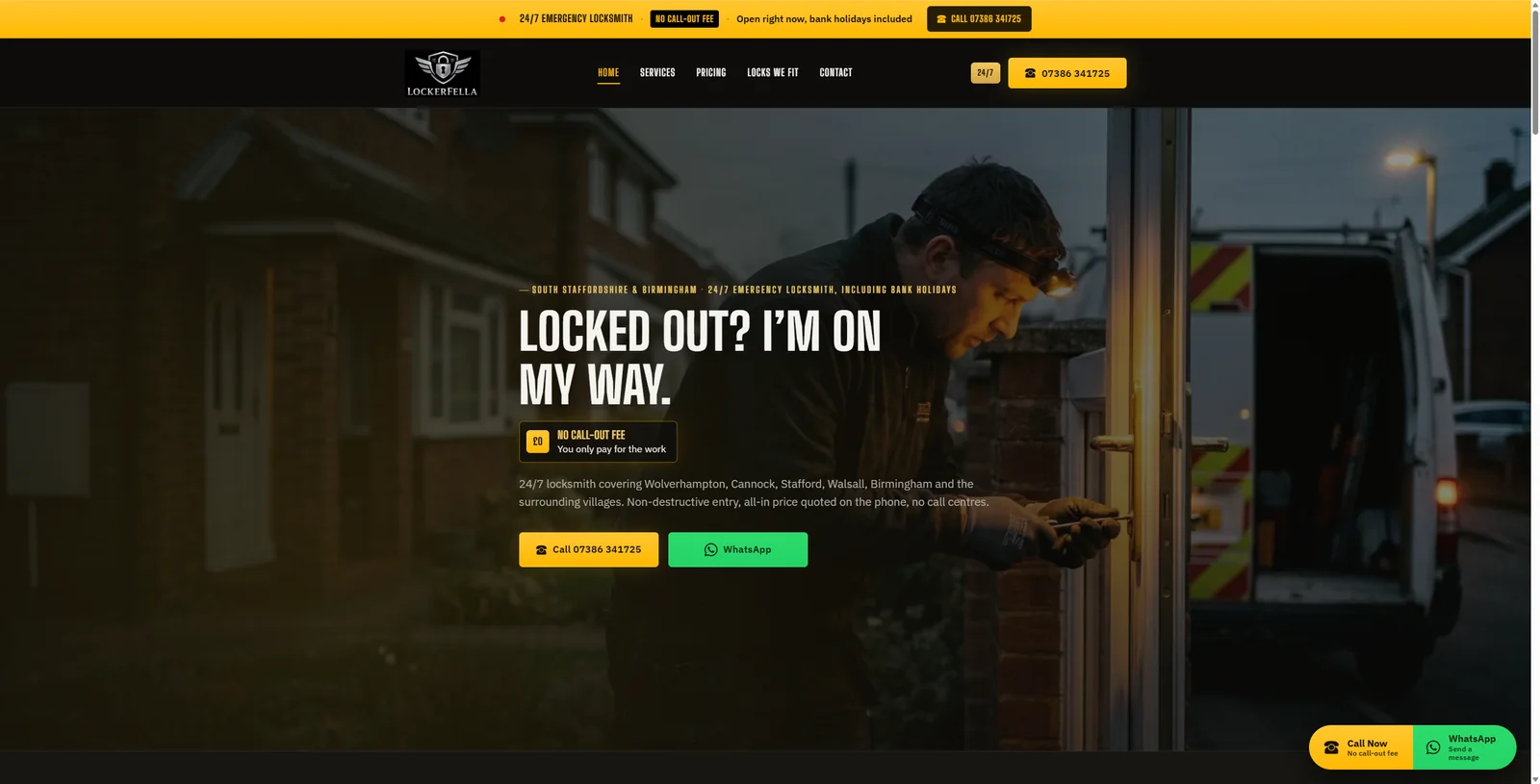
<img> with explicit dimensions and fetchpriority="high"), no carousel, no animation libraries, no third-party widgets blocking render.The bits of the platform doing the heavy lifting on Lockerfella, in order of how much work each layer is doing for that 1.7-second LCP:
The 365i CDN, with global edge caching. Static assets ship from the edge node nearest the visitor. Mobile networks are higher-latency than desktop, and round-trip time dominates the time budget on 4G. Every CSS file, every image, every JavaScript file on Lockerfella is one hop away rather than three. That's the single biggest contribution to a 1.0-second First Contentful Paint. The CDN is included on every 365i web hosting tier; there's no separate Cloudflare account, no DNS reconfiguration, no fourth subscription.
Web Optimisations, set conservatively. Because the build is already lean, the panel doesn't have much to do, but the bits it does do are real wins. Server-level HTML compression strips whitespace and comments. Image optimisation converts JPEGs and PNGs to WebP on the fly and inserts width and height attributes if any are missing. CSS combining knocks the request count down. None of this requires the application to know it's happening; it's all rewriting on the way out, between PHP and the browser.
Linux web hosting on the autoscaling cloud platform. Time to First Byte on Lockerfella sits in the 100 to 200 ms range, which is the band managed hosting should be in. Budget shared hosts often sit at 800 to 1,400 ms TTFB, which alone can put LCP into the "Poor" bucket for Core Web Vitals before the browser has rendered a pixel. The hosting tier matters even when the site is hand-coded; the OS, the PHP version, and the autoscaling architecture decide what the runtime can do.
If you've read our companion piece on how we hit 97 mobile PageSpeed on managed WordPress hosting, this is the same toolkit. The difference here is that Lockerfella isn't WordPress, so there's no theme layer, no plugin layer, and no WordPress core overhead to negotiate around. The platform rewrites and the CDN delivers; the build doesn't fight either of them. Result: a clean 100 instead of the 97 we get on a tuned WordPress site.
The area pages: a masterclass in non-commodity local SEO
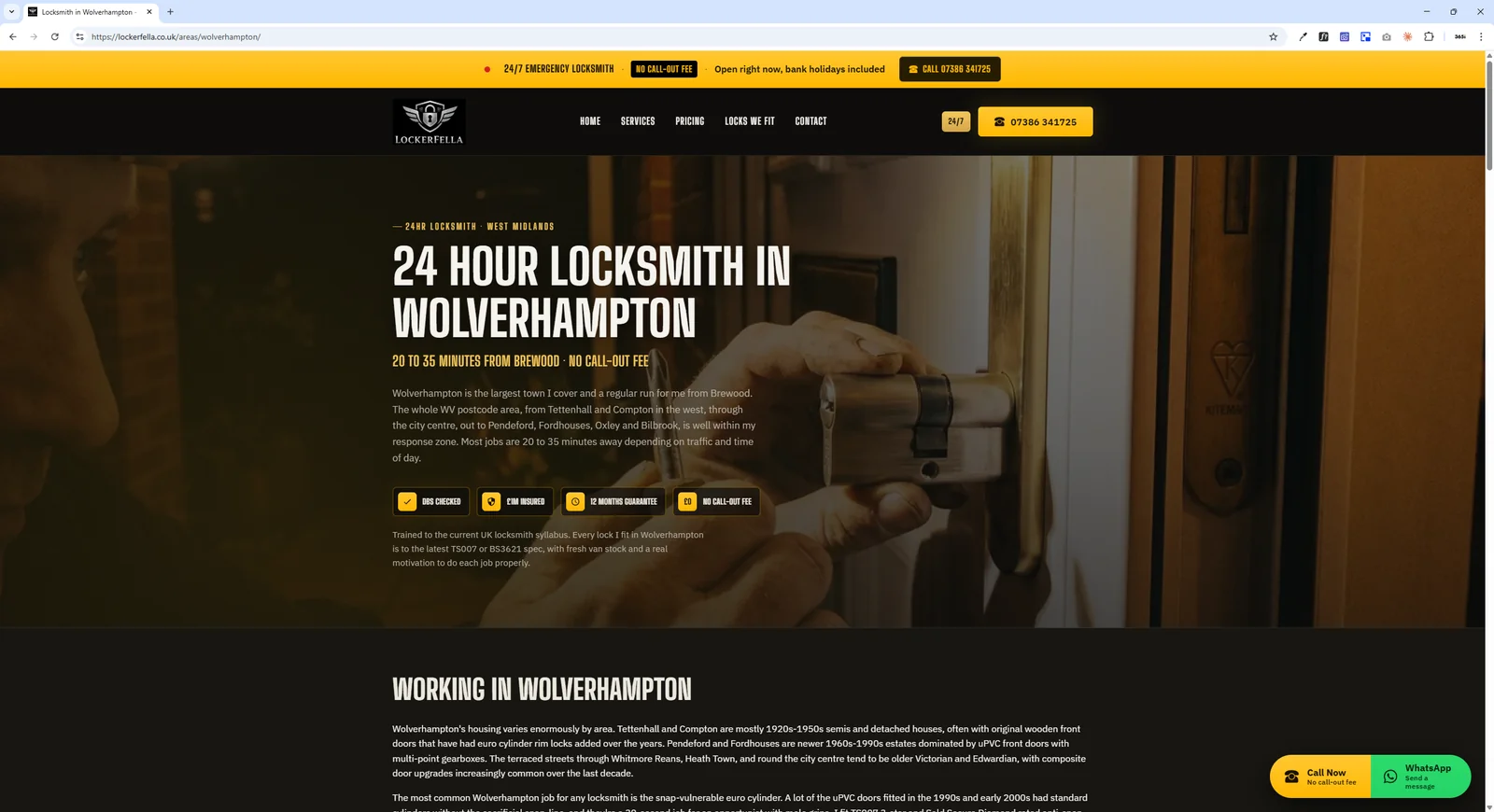
The bit that makes Lockerfella a defensible build, and the bit a competitor can't replicate by spinning up a £20-a-month theme, is the area pages.
There are eighteen of them. Each one covers a real location Sean works in, and each one reads like it was written by someone who actually goes there. The Wolverhampton locksmith page talks specifically about the housing stock in Tettenhall and Compton (1930s semis with original wooden front doors), the post-war estates around Pendeford and Fordhouses (uPVC stable-style doors), and the multi-point gearbox failures common on the late-1990s estates dominating Wednesfield. The page on locksmiths in Birmingham covers different housing patterns, different lock types, different access challenges. The Cannock locksmiths page covers different ones again.
The smaller villages get the same treatment, not a templated paragraph. If you need a locksmith in Codsall, the page covers composite-door alignment specific to the housing built off the A41. The Penkridge page handles conservation-area upgrades and the older locks that go with them. The page for an emergency locksmith in Wombourne reads as if Sean dictated it on the way back from a job, because functionally that's how it was written. The same goes for the pages covering Rugeley callouts, the Stafford locksmith page, the Walsall page, and the rest. None of it is templated. None of it could be produced by an AI scraping competitor pages.
That, more than anything else on the site, is why Google and the AI engines decided Lockerfella deserved the top result for "Brewood Locksmith". Each area page is an independent piece of evidence that this is a real locksmith working in real places, not a marketing site bolted to a call-routing service. The pages don't compete with each other internally because each one targets a distinctly different geographic query. They reinforce each other, because every one is sourced from the same person's real work diary.
Compare that to the rival pattern most local-service competitors run: a single template with the location name swapped in, the same three paragraphs of generic copy on every page, no specifics, and a contact form. Google's local quality signals can tell those pages apart from non-commodity pages with about ninety seconds of crawl time. So can ChatGPT and Gemini.
If you've read our piece on how to show E-E-A-T in 2026, this is exactly the playbook executed for a local-services business. The four letters land on two specific pages, and it's worth being explicit about which page does which work, because the design call to concentrate the trust stack rather than scatter it is the architectural decision the rest of the site rests on.
The E and the A (Experience and Authoritativeness) live on the areas page and the eighteen child pages it links to. Geographic specificity at postcode level (WV1 to WV11 for Wolverhampton, B1 to B98 for Birmingham), real response times measured from the Brewood base, named villages within each catchment, housing-stock detail no aggregator could fake. That's lived experience visible on the page. Read across all eighteen, and you have a corpus of evidence that this is a real locksmith working real routes.
The second E and the T (the other Expertise letter and Trustworthiness) concentrate on the About page. One page, one stack: named owner with photo, Certificate of Locksmith Skills with the issuing institution named, DBS check with the issue date, £1M public liability insurance with the named insurer (Simply Business) and renewal date, real registered address, 12-month workmanship guarantee, no-call-out-fee policy stated openly. Every signal a Search Quality Rater is asked to look for under SQRG §2.5.2 is on that one page, with dates and named institutions, so a rater (or a sceptical reader) can verify the claims rather than take them on trust.
The competitor pattern fails on both axes at once. Aggregator landing pages have no named human, no real address, and no credentials, so the About letter can't be built. Their templated location pages run identical copy with the town name swapped, so the area letter can't be built either. Lockerfella wins the local SERP not by outspending those competitors but by being the only result that ships both halves of the stack on a page Google's raters can actually evaluate.
The build-side view of how the eighteen area pages were structured, written, and composed is in the sister-site write-up: He asked for a proper locksmith website. He got mission control. That piece covers the architectural decisions; this one covers what the platform did to make them load in under two seconds on a mid-range Android phone.
AI search citations on day 10, with zero backlinks
The other striking thing about Lockerfella is how quickly the AI engines decided it was a credible source. ChatGPT and Gemini don't have a backlink graph to lean on the way Google traditionally has. They're working from page content, schema markup, and whatever discovery files the site exposes. So a brand-new domain with zero backlinks isn't penalised the way it would be in pure organic search; it just has to look credible.
Lockerfella looks credible to AI for the same reasons it ranks well organically:
- Schema on every page. LocalBusiness, Service, FAQPage, and Organization are emitted as JSON-LD. The areas covered, the service types, the operating hours, the named owner, all of it is machine-readable. AI engines can use it without having to extract it from prose.
- AI Discovery Files at the root domain. The full set lives at
/llms.txt,/ai.json,/identity.jsonand the others, deployed at launch. They tell language models who the business is, what it does, and how to use the site's content, in formats AI tooling expects. - Non-commodity copy. When ChatGPT pulls a recommendation for "fastest response in Brewood", it can quote real specifics from the page (~10 minute arrival, non-destructive entry, no upsell) rather than inventing a generic blurb. Sites that copy boilerplate from rivals don't give the engine anything specific to surface.
The longer version of this story is in our sister team's full case study at Press Forge: Lockerfella AI Search 10-Day Case Study, with the schema, the discovery files, and the cross-linking architecture broken down in detail. From a hosting angle, the relevant bit is that none of those things would land if the site was slow. If the LCP were 4 seconds instead of 1.7, the engines would have found a faster competitor and cited that one.
Speed isn't a ranking factor in the AI engines the way it is in Google, but it is a signal of seriousness. A locksmith site that takes 6 seconds to render on mobile reads as low-effort to a quality model. A site that lands in 1 second reads as professional. Both readings happen in milliseconds, before the engine has even started parsing the content.
For more on this point, see Mark McNeece's piece AI Visibility Explained on our sister property: "AI Visibility is not about being found. It is about being understood." A new locksmith with no backlinks isn't going to be the most-found brand in town. But it can be the most clearly understood, and that is what won here.
We came back to Lockerfella six weeks later, after Google's 15 May 2026 non-commodity guide and the May 2026 core update, to map the live AI Search outcomes across nine queries on Google, Gemini and ChatGPT. The full walkthrough, including the named framework we now apply to every site we build, is in The Receipt Test: a non-commodity local business website case study.
From Sean Hamilton, the owner
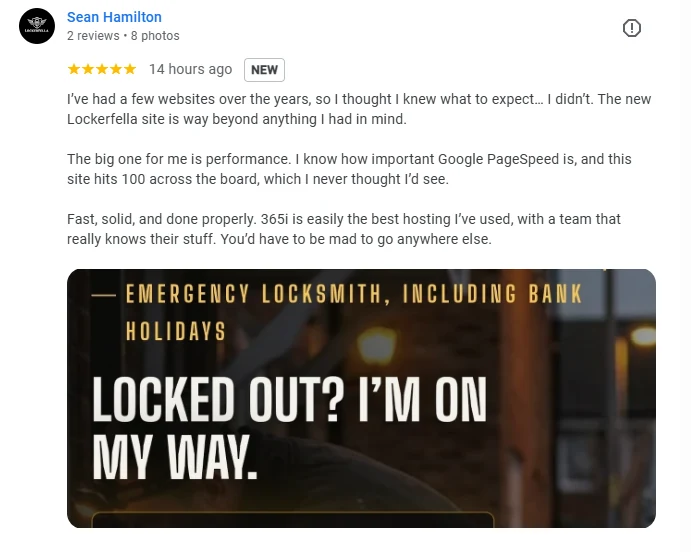
Sean dropped this into our team WhatsApp the morning after the site went live, and gave us permission to publish it:
"Honestly didn't think hosting could make this much difference. The site just flies. Everything loads instantly, no faffing about, no weird issues. It's rock solid. I've had a few sites over the years and this is on another level entirely. 365i have absolutely nailed it."
Sean Hamilton, owner of Lockerfella (WhatsApp message, April 2026).
What's worth saying about Sean is that he's not a marketing person. He's a working locksmith who covers Brewood, Wolverhampton, Cannock, and the surrounding villages, often on the same job he was doing the previous decade. The "I've had a few sites over the years" is real. He has watched hosting and design choices fail him before, on previous builds, and he was wary of being sold a story this time. The Google review went up the day after launch, on his initiative, before we'd asked. That's the kind of feedback we pay attention to. Sean has 30 years' hands-on locksmithing experience behind him; he can tell when a service delivers and when it doesn't.
Sean sat down for a longer conversation with our sister team after the launch, covering the design rationale, the area-pages strategy, the trust signals on the homepage, and what he thought he was getting versus what he ended up with. There's one line about the rebuild that keeps getting quoted internally: "I thought I was getting a smart website. I didn't realise I was getting the locksmith version of mission control." The full Q&A is at Sean Hamilton on Lockerfella.
Lockerfella vs typical UK shared hosting
The cleanest way to show what the 365i platform is doing for Lockerfella is to put the metrics next to the metrics a typical UK small business gets on a £3.99-a-month shared host. Same intent, same kind of business, very different stack. The shared-host figures below are the ranges we've measured during free migrations of incoming clients over the last year; treat them as a fair "before" rather than a worst case.
| Metric | Lockerfella on 365i | Typical UK budget shared host |
|---|---|---|
| Mobile PageSpeed Insights (Performance) | 100 | 40 to 65 |
| Largest Contentful Paint, mobile 4G | 1.7 seconds | 3.5 to 6.5 seconds |
| Server-side TTFB at origin | 28 ms (live, in our tool) | 400 to 1,400 ms |
| CDN with global edge caching | Included on every plan | Usually a paid add-on |
| Server-level HTML and image optimisation | 365i Web Optimisations panel, included | Not available; must be done at the application layer |
| PHP version available in panel | 8.5 | Often capped at 8.1 or 8.2 |
| LVE / resource limits | Unlimited LVE on autoscaling cloud | Hard CPU and memory caps, throttled at peak |
| Plan price | From £4.99/month | £2.99 to £6.99/month |
| UK data centres available | UK default, plus US and Asia | Usually US default, sometimes UK |
The cost difference between Lockerfella's hosting and the cheapest shared option is roughly £2 a month. The performance difference is the gap between a site that hits 100 mobile PageSpeed and one that struggles to break 60. For a small business whose website is its lead engine, that's not a price comparison; it's a category mistake.
What this means if you're choosing hosting
The honest version of the takeaway, written for a small business owner reading this in the middle of a hosting decision:
- Hosting alone won't get you to 100/100/100/100. No platform can fix a build that ships 800 KB of unused CSS and a render-blocking JavaScript bundle. If your existing site is in the 50s on mobile, the host migration will probably take you to the 70s or 80s. Getting to the high 90s needs the build to do its share.
- A great build on slow hosting won't get you there either. The cleanest possible PHP and CSS still has to travel over the wire. If TTFB is 1.2 seconds, your LCP cap is roughly 1.5 to 2 seconds before you've optimised anything. Shared hosting at the bottom of the price chart often runs at exactly that TTFB.
- You don't need a custom build to get to 95+. The companion piece, 97 mobile PageSpeed on managed WordPress hosting, shows the same platform getting a real WordPress site (mcneece.com) to 97. That's the realistic target for a tuned WordPress build on 365i. Lockerfella is what happens when you go bespoke; mcneece is what happens with a tuned WordPress site.
- For local-services businesses, the area pages matter more than the speed. If your hosting is fast and your area pages are templated, the speed alone won't beat a competitor with slower hosting and unique location content. The build pattern Press Forge used here (eighteen pages, every one drawn from real work) is what makes the rankings stick after Google's quality systems take a look.
The hosting that got Lockerfella to 100 from day one
Lockerfella runs on standard 365i Linux web hosting, the same platform any UK small business can sign up for. Every tier ships with the Web Optimisations panel, the 365i CDN with global edge caching, and unlimited LVE resources on the autoscaling cloud platform. From £4.99/month.
See Web Hosting PlansWhere this story breaks
The most common reaction to a case study like this is a healthy one: "yeah but my site is different." So here's the boundaries.
- If you have a CMS, you won't see 100 across the board. WordPress, Magento, Shopify, Drupal, Joomla, all of them ship with non-trivial overhead. The realistic target on a tuned WordPress build on 365i is the high 90s, with 100 across Accessibility, Best Practices, and SEO. Lockerfella's 100 on Performance is partly a build-from-scratch advantage.
- If you have a lot of third-party scripts, the ceiling drops fast. Live chat widgets, tracking pixels, A/B testing frameworks, accessibility overlays, marketing automation tags. Every one is render-blocking or main-thread heavy. Lockerfella has none of these.
- If you're in a saturated category, AI engines won't pick you up on day 10. "Locksmith in Brewood" has a small, scrappy competitive set and Lockerfella was clearly the most credible new entrant. "Locksmith in London" is a different sport. The same playbook still helps, but the time-to-citation is longer because the field of established players is larger.
- If your hosting changes the storyline, your build has to too. A migration from £3.99 shared to 365i is a step change. A site rebuild from a templated WordPress theme to a hand-coded Press Forge build is a separate step change. They compose, but they aren't substitutes.
The point of writing this up isn't to say every site can hit 100/100/100/100 by moving to 365i. It's to say that when a site does hit those numbers, the hosting is part of the story rather than an afterthought, and the build choices that go with it are the other part. Lockerfella is the cleanest demonstration we've had in a while.
FAQ
Does web hosting actually affect PageSpeed score?
Yes, by a lot. Hosting decides Time to First Byte, which on shared hosting at the budget end of the market often sits at 800 to 1,400 milliseconds. On managed hosting, TTFB lands in the 100 to 250 ms range. That single number can move Largest Contentful Paint from "Poor" to "Good" without any other change to the site. The CDN, the runtime version, and the optimisation panel compound on top.
Is a 100 mobile PageSpeed score realistic for most small business sites?
For a hand-coded site like Lockerfella, yes, on the right hosting. For a CMS-driven site (WordPress, Shopify, Magento), the realistic ceiling is high 90s. Hitting 100 across all four pillars usually requires a build with no third-party scripts, lean CSS, an LCP image with explicit fetch priority, and hosting that delivers TTFB under 250 ms. Most small business sites land in the 85 to 95 band after platform optimisation, which is plenty for ranking purposes.
Can a brand-new website rank in ChatGPT and Gemini with no backlinks?
Yes, faster than Google in our experience. AI engines don't lean on backlinks the same way Google does. They pull from page content, schema markup, and AI discovery files like llms.txt and ai.json. A new site with non-commodity copy, real schema, and the discovery files deployed can be cited within days. Lockerfella was at the top of ChatGPT and Gemini's "Brewood Locksmith" answers by day 10, with zero backlinks.
What is non-commodity content for local SEO?
Non-commodity content is location- or experience-specific information that no rival could produce by copying templates or scraping the SERP. For a locksmith, it's the actual housing stock in a real town, the actual lock failure patterns, real call-outs with dates, named jobs with real outcomes. Google's quality systems and the AI engines can both tell non-commodity content apart from templated doorway pages within seconds of crawling.
Why are templated area pages worse than unique ones?
Two reasons. First, Google treats them as low-quality and may demote or de-index them as doorway pages. Second, AI engines have nothing distinct to cite when answering a location-specific query, so they go to a competitor with real local detail. A template that swaps "Wolverhampton" for "Birmingham" without changing anything else is worse than no area page at all.
What hosting is best for a fast UK small business website?
For a UK audience, UK-default data centres matter for Time to First Byte. For a fast site, three platform features matter: a CDN with global edge caching included, server-level optimisation that rewrites HTML and images on the way out, and a current PHP runtime (8.4 or 8.5). 365i web hosting ships all three on every tier from £4.99/month, with UK, US, and Asia data centres available.
Who built the Lockerfella site?
Press Forge, our sister design studio (rebranded from The WordPress Company in April 2026). Press Forge handle bespoke design and front-end builds for clients hosted on 365i. Same property, same team underneath, separate brand because design and hosting are different jobs that buyers shop for differently.
How can my business get similar results?
Three things, in order. One: get on hosting that doesn't cap your performance at the network layer. Two: invest in a build that's appropriate for the speed target you want (a tuned WordPress build can hit 95+; a bespoke build can hit 100). Three: write content that's specific to your locations, services, and customers, not lifted from a template. The third item is the slowest and the hardest, but it's the one that produces rankings that survive a Google update.
How much does fast UK web hosting cost?
365i web hosting starts at £4.99/month and includes the CDN, the Web Optimisations panel, PHP 8.5, and unlimited LVE resources on the autoscaling cloud platform. That's the same plan Lockerfella runs on. Faster managed tiers go up to roughly £15-25/month for very high-traffic stores or sites that need 4.20 GHz Turbo compute. The pricing gap between fast UK hosting and the cheapest shared options is usually £2 to £4/month, which is small relative to what you'd spend on a single Google Ads click in most local-services niches.
How long does it take a new website to rank on Google?
It varies hugely by competitive set, but the Lockerfella build hit #1 organically for "Brewood Locksmith" by day 12, and the AI engines (ChatGPT, Gemini) cited it from day 10. That's faster than most case studies report. The reasons are specific: a clean technical baseline (perfect mobile PageSpeed, full schema, AI Discovery Files at the root), eighteen non-commodity area pages with real local detail, and a competitive set that wasn't doing any of those things. In a saturated category like "Locksmith London", the same build pattern would take longer because the bar competitors clear is higher.
What's the best web hosting for UK tradesmen and local-services businesses?
For UK tradesmen, electricians, plumbers, locksmiths, builders, and similar local-services businesses, the priorities are mobile speed (most enquiries come from a phone, often when the visitor is locked out, flooded, or otherwise stressed), local-search visibility (Google Business Profile plus area pages with real local content), and a UK-default data centre for low Time to First Byte. 365i web hosting from £4.99/month covers all three. The Lockerfella case study above shows what's achievable on the cheapest tier when the build is also done properly.
Sources
The case
Cited area pages
- Birmingham locksmith
- Wolverhampton locksmith
- Walsall locksmith
- Stafford locksmith
- Cannock locksmith
- Full list of area pages
Sister-property reading
- Lockerfella: AI Search Visibility in 10 Days
- Press Forge WordPress Design
- AI Visibility
- AI Visibility Explained
Related reading on 365i
Published: · Last reviewed: · Written by: Mark McNeece, Founder & Managing Director, 365i
Editorially reviewed by: Mark McNeece on · Our editorial standards