

On 30 April 2026 Google's Preferred Sources feature went global, with the publisher guide on Search Central updated the same day. Readers in any supported language can now mark publishers they trust, and Google will prioritise those publishers in their Top Stories carousel. Marked sources get clicked twice as often, Google says, and 200,000+ unique sites have already been picked.
That's the news. The honest sub-text from this corner of the publishing world is sharper. Our Discover impressions on 365i.co.uk for the last twelve months total 64. Total clicks: 10. We've kept publishing one or two news-style posts a week through that whole period. So when Google shipped a feature that lets readers manually override the algorithm we've been waving at, I wanted to test it on the spot. Here's what changed, what we deployed on this site this week, and what UK SME publishers should think about before they spend any time on it.
What Changed on 30 April
Preferred Sources isn't new in concept. Google launched it in the US and India in August 2025, then expanded to English-language users globally in December 2025. The 30 April release is the moment it became universal: every supported language, every country where Google Search runs.
Two things shifted alongside the language switch. First, the publisher documentation on Search Central was rewritten with formal guidance: a standard deeplink format (https://google.com/preferences/source?q=YOUR-DOMAIN) and downloadable button assets in 16 languages so publishers don't have to design their own. Second, the eligibility rules were spelled out clearly. Only domain-level and subdomain-level sites appear in the tool; subdirectories like example.com/blog are not eligible.
Search Engine Land's Barry Schwartz summarised the change on the morning of 30 April: "Preferred Sources was supported globally but English only, now it works for all languages." 9to5Google's walkthrough covered the consumer side, and Search Engine Journal framed it as a new global SEO signal.

What Preferred Sources Looks Like
For readers, Preferred Sources lives inside the source preferences tool. You can reach it from a Top Stories carousel by tapping the small icon, or open it directly with a link. For publishers, the tool decides whether your site even appears. Eligibility isn't a ranking judgment; it's a structural rule. Domain or subdomain entities qualify, and Google notes in its docs that "sources that are not updated regularly may be unavailable", which suggests publishing cadence matters.
I tested 365i.co.uk in the tool while writing this. The result is the screenshot below. We do appear, with the right favicon and the right domain, and the checkbox to add us is one tap. (The "Your sources (0)" line at the bottom is mine. I added 365i to my own preferred sources right after taking the screenshot. It felt slightly absurd, but it's the kind of thing every publisher writing about this feature should do first.)
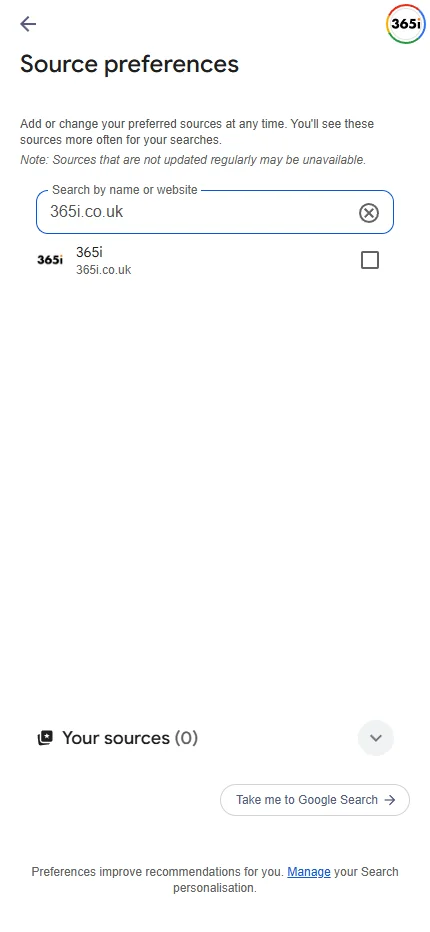
If you want to test your own site, the deeplink format is identical. Substitute your domain after the ?q=. Open it on your phone signed into Google. If your site appears, you're eligible and the button on your site will work for everyone else too.
Our Discover Reality: 10 Clicks in 12 Months
Here's the Search Console screenshot for the last twelve months on Discover. Two visible spikes, otherwise flat.
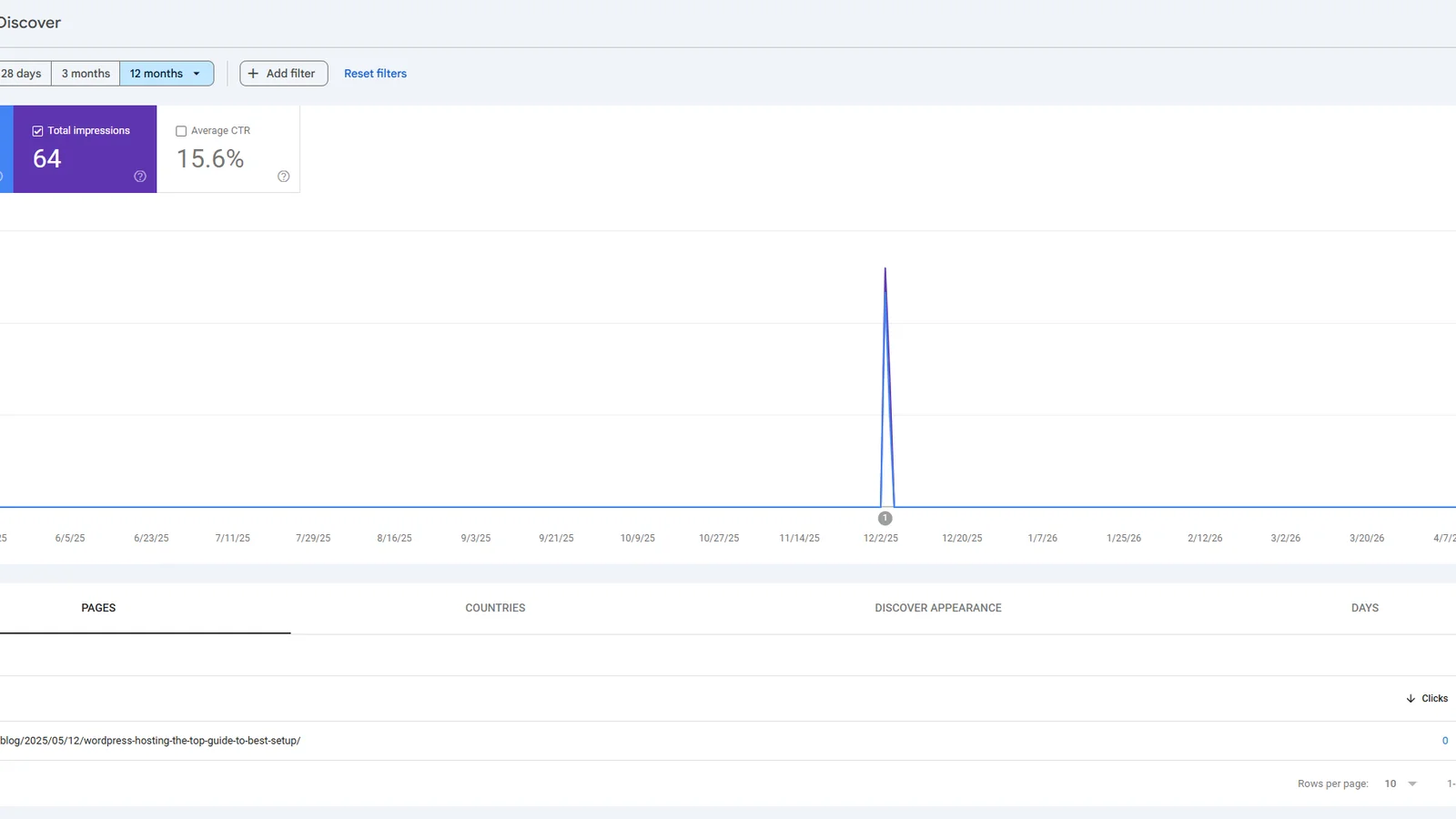
We covered the wider story when it broke: Google's December 2025 core update wiped out Discover traffic for thousands of publishers, with reported drops as severe as 98%. We weren't a Discover-dependent site to begin with, so the December event didn't break a business model. It did confirm what the chart shows: for sites of our scale, Discover has been functionally absent. The 15.6% CTR is the interesting data point. When we did surface, readers clicked. The question isn't "are we relevant?", it's "can we get in front of anyone?".
That's exactly the gap Preferred Sources is designed to bridge. It moves a small slice of distribution power from the algorithm to the reader. If you've been waiting for the algorithm to reconsider you, the algorithm wasn't planning to. A reader marking you as preferred bypasses that decision.
What We Deployed on 365i.co.uk
While writing this we shipped a Preferred Sources prompt on 365i.co.uk in two places:
- A gold-trimmed card on the News hub, between the hero and the featured article, prominent without being aggressive.
- An inline version at the foot of every news article (you'll see it just below this text), placed where engaged readers naturally pause.
The implementation is small. A reusable PHP component, around 50 lines, with a star icon and a single CTA pointing at the documented deeplink: https://google.com/preferences/source?q=365i.co.uk. There's no JavaScript, no consent gating, no third-party script. Tapping the button opens Google's preferences tool in a new tab and the user does the rest. Total build and deploy time: about 30 minutes including styling and a local PHP lint. We did not pay anyone, design anything bespoke, or wait for a release window.
If you've ever wired up a "Share on LinkedIn" button you've already done a more complicated job than this. The only fiddly part is making the CTA visually distinct from your existing social calls to action; readers will skip another grey "follow us" button. We went for a warm gold theme so the prompt reads as something different from the usual social tray.
Is It Worth It? The Skeptical View
Google's claim is that marked sources get clicked twice as often. That's a strong number, but worth treating with some scepticism, because no one outside Google can verify it for their own site yet. Preferred Sources doesn't appear in Search Console as a separate dimension. Publishers can't see how many readers added them, when those readers saw their content, or how many of the resulting clicks would have happened anyway.
The Guardian's SEO strategist Jessie Willms made the point directly to Digiday:
"When Google doesn't make it easy to track something, it's probably because it's not necessarily a positive for publishers."
Jessie Willms, SEO strategist at The Guardian, quoted by Digiday (February 2026)
That's a fair point and it's worth carrying through to your own thinking. If you're a UK SME publisher, the deciding factor isn't whether Preferred Sources will single-handedly recover your Discover numbers. It probably won't. The deciding factor is whether the cost of asking, an extra CTA on your most engaged pages, is small enough to be worth doing on the chance that a few of your existing readers will tap it. For us, the cost is roughly zero and the expected upside is small but positive. That maths usually points at "do it".
What UK SME Publishers Should Do
Three things, in order:
- Check eligibility. Open
https://google.com/preferences/source?q=YOUR-DOMAINon your phone signed into Google. If your site appears, you're in. If it doesn't, look at why. Publishing cadence and domain-level entity status are the two factors Google flags. We publish one to two news-style posts a week and we appear; sites that haven't published in months may not. - Add a button on your most-engaged pages. The end of long-form articles is the right placement for most publishers. Consider one in your footer too. Google ships downloadable button assets in 16 languages if you don't want to design one.
- Treat it as a parallel signal, not a replacement. Preferred Sources is a small piece of a much bigger picture. Strong on-page E-E-A-T, an AI-discoverable identity, and a defensible SEO foundation still matter more. Our sister site has a similar argument for AI search at AI Visibility vs SEO.
One caveat for non-publisher readers: Preferred Sources is a news-publisher mechanism. If you run a local-services site, an e-commerce store, or any site that doesn't publish news-style content on a weekly cadence, the deeplink will return "no results" and there's nothing to opt into. For those sites, the equivalent ranking-distribution move is winning local or topical authority on the organic side, which still rewards the same E-E-A-T inputs (real human, real credentials, real geographic specificity, machine-readable schema). The cleanest worked example we've shipped is Lockerfella, a brand-new locksmith site we launched in April 2026. Eighteen dedicated area pages with postcode-level specificity (WV1 to WV11 for Wolverhampton, B1 to B98 for Birmingham), and an About page that ships every signal a Search Quality Rater would ask for (named owner with photo, Certificate of Locksmith Skills with the issuing institution named, dated DBS check, £1M public liability insurance with the named insurer and renewal date). Twelve days after launch the site was ranking #1 for "Brewood Locksmith" on Google, ChatGPT, and Gemini, with zero backlinks and no Preferred Sources mechanism in play. We have written the full evidence-led walkthrough as The Receipt Test: a non-commodity local business website case study, including the AI Search outcomes across Google, Gemini and ChatGPT mid-core-update. Authority earned that way is portable across surfaces, which is the wider point: build for the rater's checklist on every page, and the algorithm has fewer reasons to skip you in the first place.
Whether this needle moves for our 10-clicks-a-year corner of Discover, we'll know in a few months. We'll add an update block to this article when there's something measurable to say.
Frequently Asked Questions
What is Google Preferred Sources?
It's a Google Search feature that lets readers mark publishers they trust. Google then prioritises those publishers in the reader's Top Stories carousel for relevant news searches. It launched in the US and India in August 2025, expanded to global English in December 2025, and rolled out to all supported languages on 30 April 2026.
Is my website eligible for Preferred Sources?
Open https://google.com/preferences/source?q=YOUR-DOMAIN on a phone signed into Google. If your site appears in the tool with its favicon and a checkbox, you're eligible. Only domain-level and subdomain-level entities qualify; subdirectory paths don't appear. Google notes that sources not updated regularly may be unavailable.
How do I add a Preferred Sources button to my site?
Link to https://google.com/preferences/source?q=YOUR-DOMAIN from a button or text link on your site. Google provides downloadable button assets in 16 languages from its Search Central documentation, or you can design your own. Place it where engaged readers will see it, typically the end of articles or the footer, alongside your social calls to action.
Does Preferred Sources affect Discover or just Top Stories?
The documented effect is on the Top Stories carousel inside Google Search. It surfaces preferred publishers more prominently for relevant news queries. Google has not extended the feature to the Discover feed itself, although the underlying signal of reader-declared trust is the same kind of input both surfaces could use.
Will being marked as a preferred source boost my search rankings?
No. Preferred Sources doesn't change underlying ranking. It's a personalisation layer that prioritises selected publishers in Top Stories for the user who selected them. It doesn't alter your ranking in regular organic search results, and it doesn't influence how other users see your content.
Is Preferred Sources available in the UK?
Yes. UK readers had access from the December 2025 English-language expansion. The 30 April 2026 release added every other supported language, so the feature is universally available across the UK regardless of the user's language settings.
What does the deeplink URL look like?
It's https://google.com/preferences/source?q=YOUR-DOMAIN. For example, https://google.com/preferences/source?q=365i.co.uk. Google's Search Central documentation lists this as the official format for publishers to use in social posts, marketing assets, and on their own websites.
Will it help my site recover from the December 2025 Discover collapse?
It might help at the margins, but it isn't a recovery mechanism for Discover itself. Preferred Sources only affects Top Stories, and only for users who choose to mark you. If you lost most of your Discover traffic in December 2025, the underlying issue (algorithmic deprioritisation) still needs addressing through content quality, E-E-A-T signals, and broader SEO. Preferred Sources is a useful parallel signal, not a substitute.
Do I need to register in Google Publisher Center to be a Preferred Source?
No. Publisher Center is a separate Google product covering Google News Showcase, Reader Revenue Manager, and Following. Preferred Sources eligibility is automatic, decided by Google's normal news-style content crawl. The only check that matters is whether your domain appears in the source preferences tool when you open the deeplink. If it does, you are eligible regardless of Publisher Center status.
Free Webmaster Tools, Built by 365i
While Google works out who readers prefer, you can audit the technical foundations that make any visibility worth having. Eight free tools, no sign-up, no rate limits.
Explore the Free ToolsSources
- Google Search: Preferred Sources now available in all languages - Google Blog (30 April 2026)
- Guide to Preferred Sources in Google Search for Web Publishers - Search Central (updated 30 April 2026)
- Google expands 'Preferred Sources' to everyone - 9to5Google (30 April 2026)
- Google Preferred Sources now works for all languages - Search Engine Land (30 April 2026)
- Google's Preferred Sources Is Now A Global SEO Signal - Search Engine Journal (30 April 2026)
- Without transparency, publishers can't tell if Preferred Sources benefits them - Digiday (February 2026)
- Google updates Preferred Sources guide, doubling publisher click-through rates - PPC Land (April 2026)
Published: · Last reviewed: · Written by: Mark McNeece, Founder & Managing Director, 365i
Editorially reviewed by: Mark McNeece on · Our editorial standards
